

Product Overview
Happiness and self-esteem are related but distinct concepts. They are similar in that both involve subjective judgments of oneself. However, subjective appraisals do not line up neatly with objective circumstances, so the only way to know how students feel about their lives or themselves is to ask them. Teachers and parents may overlook a student whose condition at school seems fine or even great, for instance, thinking that a bright, attractive student from a wealthy family should be happy. However, well-being is influenced by many factors, as described below. Whereas some students who face the most challenging conditions report being happy and satisfied, others who appear to have everything report feeling dissatisfied with their lives.
About the Authors
Shannon M. Suldo, PhD, is a professor in the School Psychology Graduate Training Program at the University of South Florida. She has studied children’s and adolescents’ happiness for over 25 years. She is the author of Promoting Student Happiness: Positive Psychology Interventions in Schools (Suldo, 2016), and coeditor of Fostering the Emotional Well-Being of Our Youth: A School-Based Approach (Lazarus, Suldo, & Doll, 2021) and the third edition of Handbook of Positive Psychology in Schools: Supporting Process and Practice (Allen, Furlong, Vella-Brodrick, & Suldo, 2022).
Cydney E. Williams, MA, is a doctoral student in the School Psychology Program at the University of South Florida. She teaches a service learning course on Positive Psychology in the Schools.
This NASP Laminated Guide is an updated version of a resource from Helping Handouts: Supporting Students at School and Home, an online digital publication featuring more than 80 handouts for educators and caregivers. To learn more about Helping Handouts, visit https://apps.nasponline.org/resources-and-publications/book-store.aspx.
ISBN: 978-0932955-43-2
This 6-page, laminated quick-reference guide is must for any School Psychologist or educator. This guide includes information on:
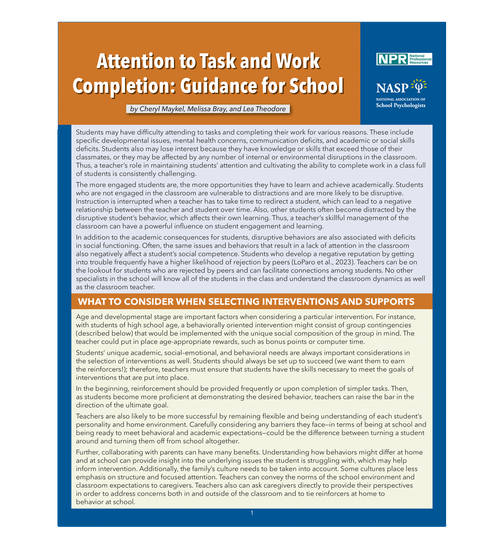
- What to Consider When Selecting Interventions and Supports
- Biological Factors
- Demographic Factors, Developmental State, and Culture
- Environmental Factors and Intentional Activity
- Recommendations
- Forming Foundational Healthy Practices
- Facilitating Brief Interventions From Positive Psychology
- Strengthening Relationships
- Building Healthy Settings and Systems
- Recommended Resources for Teachers and the School
- Recommended Resources for the Home