

Product Overview
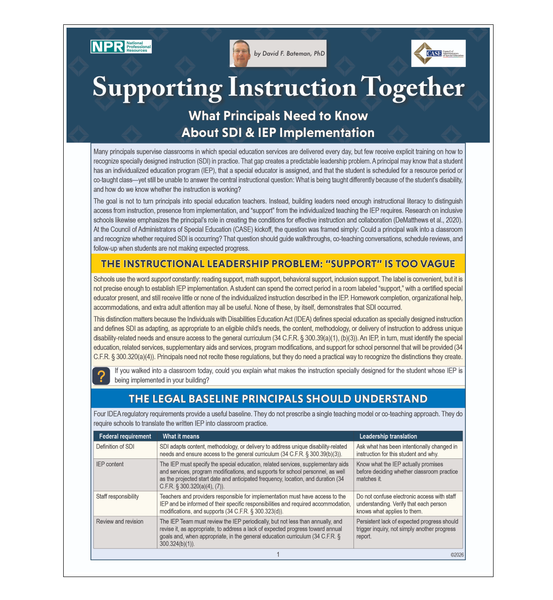
Principals do not need to become special education teachers. They need to recognize specially designed instruction when they walk into a classroom. Using seven lessons, three ready-to-use tools, and one student's story, Dr. David F. Bateman shows school leaders how to tell "support" from the individualized teaching an IEP requires.
A student can sit in the right room, in the right period, with a certified special educator, and still get little of the instructions the IEP promises.
Many principals supervise classrooms where special education services are delivered every day, yet few have been trained to see specially designed instruction (SDI) in practice. They may know a student has an IEP and a scheduled resource or co-taught period, and still be unable to answer the central question: what is being taught differently because of this student's disability, and how do we know it is working?
Supporting Instruction Together: What Principals Need to Know About SDI & IEP Implementation is a 6-page laminated quick-reference guide by David F. Bateman, PhD, created with the Council of Administrators of Special Education (CASE). It gives building leaders a practical way to separate access from instruction, presence from implementation, and "support" from SDI, without asking them to master every teaching method.
The guide turns the IDEA definition of SDI into an observation framework: what has been adapted in content, methodology, or delivery, and who is doing the teaching? It shows how to tell accommodations, general interventions, SDI, and homework help apart, and how the same strategy can serve different functions. It also treats co-teaching as a service-delivery model, not proof of SDI, and offers a five-minute planning protocol and a co-teaching reality check.
Jordan, a composite sixth grader with a specific learning disability in reading and ADHD, anchors the guide. His IEP requires 45 minutes of daily specially designed reading instruction, yet his "reading support" period has drifted toward finishing general education assignments, his teacher has been absent repeatedly, and his progress is flat. The guide uses his case to separate two questions leaders often blur: was the IEP implemented as intended, and if so, is it working?
The guide is grounded in IDEA regulations, including 34 C.F.R. §§ 300.39, 300.320, 300.323, and 300.324. It also draws on Endrew F. v. Douglas County School District RE-1 (2017), William A. v. Clarksville-Montgomery County School System (6th Cir. 2025), in which a student with dyslexia graduated with a 3.4 GPA yet still could not read and the court affirmed 888 hours of compensatory tutoring, co-teaching research, high-leverage practices, and the U.S. Department of Education's 2025 guidance on inclusive practices.
Laminated for durability and built for use in walkthroughs, schedule reviews, co-teaching conversations, and follow-up when progress stalls. Not a textbook to read once, but a reference leaders keep at hand.
What's Inside
The Instructional Leadership Problem: "Support" Is Too Vague
- Why a room labeled "support," a certified special educator, and extra adult attention do not show that SDI occurred
- The central walkthrough question: could a principal walk into a classroom and recognize whether required SDI is happening?
- The legal baseline: four IDEA requirements (the definition of SDI, IEP content, staff responsibility, and review and revision) with a leadership translation for each
Lesson 1: Distinguish Accommodations, Interventions, SDI, and Assignment Help
- A side-by-side table of each practice's primary function and the question a principal should ask
- Why the same technique can serve as universal practice, an accommodation, an intervention, or part of SDI
- Leadership Caution: stop asking "Is this strategy SDI?" and ask what makes its use specially designed for this student
Lesson 2: Look for Individualization in Content, Methodology, and Delivery
- The three dimensions of adaptation from the IDEA definition, with examples of observable evidence for each
- How strong SDI often changes more than one dimension at once
- The principal's role: judge whether the teaching is individualized and explainable, not prescribe the technique
Lesson 3: Conduct Walkthroughs That See More Than Adult Presence
- Six things to look for, a stronger observation question for each, and the evidence that answers it
- What a walkthrough cannot prove, and the patterns that warrant a deeper review
- Walkthrough Rule: know what question to ask next without mistaking a brief observation for an implementation audit
Lesson 4: Co-Teaching Is a Service-Delivery Model, Not Proof of SDI
- What the research on co-taught classrooms does and does not show
- Six co-teaching approaches (parallel, station, alternative, one teach/one assist, one teach/one observes, and teaming) with what each can accomplish and a leadership watch point
- Why one teaches, one assist is a poor default
Lesson 5: Shared Accountability for IEP Implementation
- A five-minute co-teaching planning protocol that keeps protected planning time focused on instruction
- Who is responsible for what: principal, special education teacher, general education teacher, related service provider, and special education director
- Five ways to support general education teachers without handing them a legal manual
Lesson 6: Use Jordan to Test the Instructional System
- A composite case from the CASE kickoff: a "reading support" schedule, homework help, repeated teacher absences, flat progress, and parent concern
- A signal-by-signal table linking each warning sign to an instructional question and a leadership response
- Current case: William A. v. Clarksville-Montgomery County School System (2025) and why grades are not the same as skill acquisition
Lesson 7: When Progress Is Weak, Separate Implementation from Effectiveness
- Two questions, in order: was the IEP implemented as intended, and if so, is it producing adequate progress?
- What to do in each case, including documenting missed instruction and deciding what to intensify, adapt, or revise
- Legal context from Endrew F. v. Douglas County School District RE-1 (2017)
Three Tools Principals Can Use Immediately
- The 60-Second SDI Walkthrough: six questions leading to one of three outcomes
- The Co-Teaching Reality Check: five questions to ask both teachers separately, with what a strong answer sounds like
- The "Support-to-Instruction" Audit: examine a week of one resource period, co-taught class, or intervention block to see whether the label is masking instructional drift
Instructional Leadership Self-Audit
- Ten statements to mark Yes, No, or Not Sure, designed to find where instructional ambiguity could become a student problem
- Final takeaway: instructional visibility, not expertise in everything
Who It's For
- Principals and assistant principals
- Directors and coordinators of special education
- Special education teachers and co-teaching partners
- General education teachers who serve students with IEPs
- Related service providers and instructional coaches
- Leadership teams building walkthrough, co-teaching, and progress-review routines